MURPHY OIL (MUR)·Q4 2025 Earnings Summary
Murphy Oil Beats on Production, Raises Dividend 8% as Vietnam Exploration Delivers
January 29, 2026 · by Fintool AI Agent
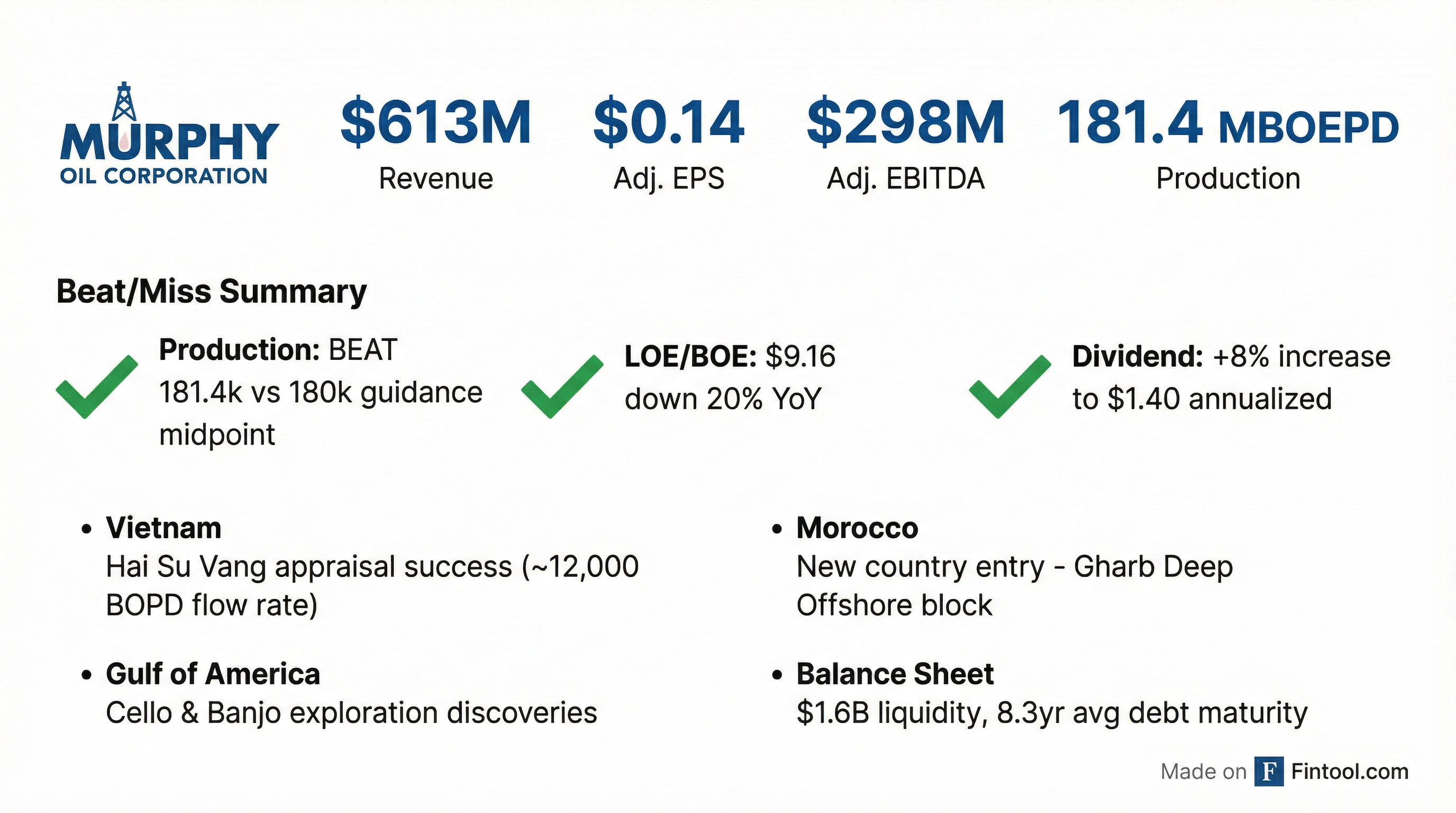
Murphy Oil (NYSE: MUR) reported Q4 2025 results that exceeded production guidance while delivering major exploration success in Vietnam. The company produced 181,400 BOEPD, beating the 180,000 midpoint of guidance, and announced an 8% dividend increase to $1.40 annualized.
The stock traded down 2.6% to $31.42 on the day of the release, as investors weighed lower 2026 production guidance against the long-term value of Vietnam discoveries.
Did Murphy Oil Beat Earnings?
Murphy exceeded operational guidance across key metrics in Q4:
Full Year 2025 Summary:
The quarter saw no new wells come online, causing sequential production decline from Q3's 200 MBOEPD. Operating expense per BOE of $9.16 benefited from a one-time $15M insurance reimbursement ($0.90/BOE impact).
2025 Proved Reserves: Murphy maintained 715 MMBOE of year-end proved reserves with 103% total reserve replacement. The Pioneer FPSO acquisition added ~16 MMBOE in the Cascade and Chinook fields. Proved reserve life stands at 11 years with 57% proved developed and 41% liquids-weighting.
 Ask Fintool AI Agent
What Made Vietnam the Headline?
The Hai Su Vang-2X appraisal well delivered exceptional results, validating Murphy's exploration thesis in offshore Vietnam:
- Net Pay: 429 feet of oil pay across two reservoirs — 332 feet in primary reservoir, 97 feet in shallow reservoir
- Flow Rate: ~12,000 BOPD aggregate from primary reservoir (tested in two sections at ~6,000 BOPD each)
- Hydrocarbon Column: Extended to ~1,600 feet after deepening oil-down-to by 413 feet without water
- Resource Upgrade: Primary reservoir midpoint raised toward high end of 170-430 MMBOE range (shallow reservoir not included)
- Industry Recognition: Wood Mackenzie called it "the largest oil find in Southeast Asia in the last two decades"
Murphy's Vietnam portfolio now includes:
- Lac Da Vang (Golden Camel) — Development on track for first oil Q4 2026
- Hai Su Vang (Golden Sea Lion) — Two additional appraisal wells planned in 2026
- Lac Da Hong (Pink Camel) — 2025 exploration success
Management expects Vietnam to produce 30-50 net MBOEPD in the early 2030s, representing a material new growth engine.
How Did Other Exploration Perform?
Gulf of America — Two Discoveries:
- Cello #1: 30 feet net pay — will tie back to Delta House FPS
- Banjo #1: 50 feet net pay — infrastructure-led tie-back
- Won 14 exploration blocks in December 2025 lease sale
Côte d'Ivoire — One Dry, Two to Drill:
- Civette-1X encountered non-commercial hydrocarbons
- Caracal (Block CI-102): 150-360 MMBOE mean-to-upward resource potential, spud Jan 2026
- Bubale (Block CI-709): 340-850 MMBOE mean-to-upward resource potential
- Drilling with Transocean Deepwater Skyros at $361k/day
Morocco — New Country Entry:
- Signed Petroleum Agreement for Gharb Deep Offshore block (4M+ acres)
- 75% working interest, no firm well commitments in initial 3-year phase
What Did Management Guide for 2026?
Murphy provided 2026 guidance that reflects operational transitions:
Why Production Declines:
- Tupper Montney natural gas volumes 10% lower YoY due to smaller well program and higher royalty rates (expected ~9% vs 5% in 2025)
- Gulf of America 10% lower YoY with minimal new production online before Chinook #8 in H2 2026
- However, higher AECO prices boost revenue — Tupper expected to generate 35%+ more cash flow in 2026 vs 2025
2026 Production by Asset:
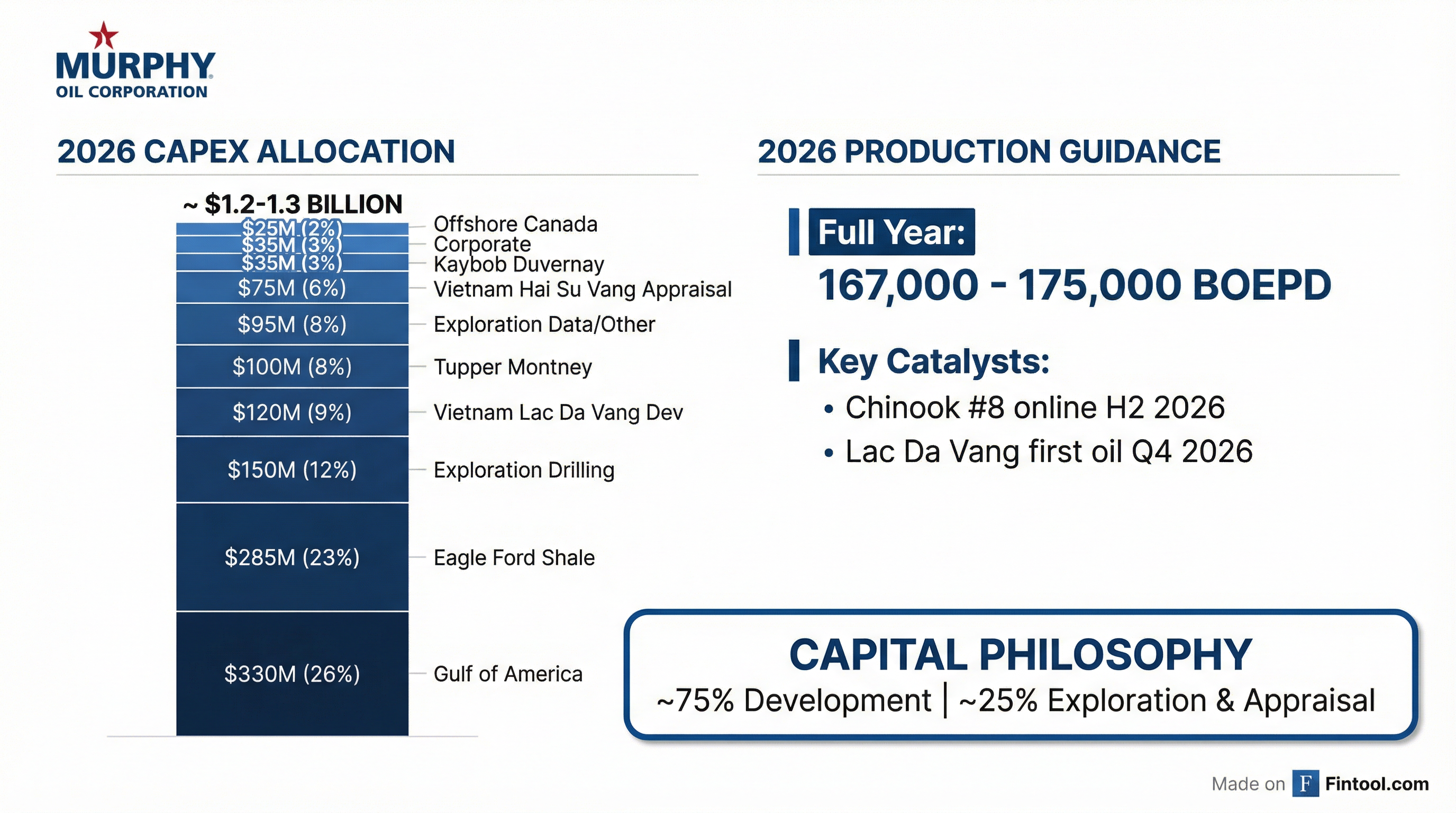
Key 2026 Catalysts:
- Chinook #8 development well online H2 2026 (+11 MBOEPD net)
- Lac Da Vang first oil Q4 2026
- Two Hai Su Vang appraisal wells (HSV-3X and HSV-4X) in H1 2026
2026 Capex Allocation ($1.2-1.3B):
70% of capex weighted to H1 2026.
Ask Fintool AI AgentHow Deep Is the Inventory?
Murphy's onshore assets provide decades of drilling runway at current activity levels:
The offshore portfolio adds 28 projects with 240 MMBOE of total resources at <$40/BBL WTI breakeven, plus 15 additional projects (30 MMBOE) above that threshold. 58% of offshore projects are in the Gulf of America, 35% in Offshore Canada, and 7% in Southeast Asia.
How Strong Is the Balance Sheet?
Murphy ended 2025 with a fortress balance sheet and proactively enhanced liquidity in early 2026:
January 2026 Actions:
- Issued $500M of 6.50% senior notes due 2034
- Redeemed $227M of 2027/2028 notes
- Paid off $100M revolver balance
CEO Eric Hambly: "We proactively strengthened our balance sheet and enhanced liquidity to position ourselves to invest confidently through temporary dips in the market."
What About Shareholder Returns?
Murphy's capital allocation framework prioritizes minimum 50% of adjusted free cash flow to shareholder returns:
Dividend Increase:
- Quarterly dividend raised 8% to $0.35/share ($1.40 annualized)
- Payable March 2, 2026 to shareholders of record February 17, 2026
- $550M remaining on share repurchase authorization
How Did the Stock React?
MUR traded down 2.6% to $31.42 on the earnings release, with aftermarket trading at $31.21. The stock remains near its 52-week high of $35.19.
The muted reaction likely reflects:
- Production guidance ~6% below 2025 levels
- Civette dry hole in Côte d'Ivoire
- Vietnam upside largely priced in after prior announcements
What Changed From Last Quarter?
New Developments This Quarter:
- Hai Su Vang-2X appraisal success (post quarter-end)
- Cello #1 and Banjo #1 discoveries announced
- Morocco new country entry signed
- Credit facility upsized and extended
Q&A Highlights
On Hai Su Vang Test Rates (Paul Cheng, Scotiabank): The 12,000 BOPD flow rate came from two separate flow tests at ~6,000 BOPD each, conducted in sequence due to well mechanics. Unlike the discovery well (which was facility-constrained at 10,000 BOPD), the appraisal well rate reflects true reservoir deliverability — "extremely high production rates for this basin" where typical wells produce ~2,000 BOPD.
On CapEx Flexibility (Paul Cheng, Scotiabank): Management outlined flexibility hierarchy:
- Non-negotiable investments: Lac Da Vang development (first oil Q4), Côte d'Ivoire exploration (two prospects), Hai Su Vang appraisal (two wells), Chinook #8 development well
- 2026 flexibility: ~10% reduction possible by adjusting final 3-4 months of GoA rig program, Eagle Ford, and onshore Canada (though most onshore activity is front-half weighted)
- 2027 flexibility: If extended low oil prices, 30-40% capex reduction possible as 2026's "must-do" projects won't repeat
On Civette Dry Hole (Carlos Escalante, Wolfe Research): The well found sands and oil pay as the geologic model predicted — just not in commercial quantities. CEO Hambly: "It's always disappointing to drill a dry hole. It is nice, however, that the model we put together about trying to understand the geology and what's happening held together." Importantly, Caracal and Bubal prospects are independent plays targeting different-age reservoirs with no dependence on Civette results.
On Vietnam Scale (Carlos Escalante, Wolfe Research): When asked if the 30-50 MBOEPD Vietnam target by early 2030s undersells the opportunity given HSV's size (potentially 4x larger than LDV), Hambly cautioned: "We're not attempting to be overly aggressive in what we think may happen from the field... At the end of collecting data from those two appraisal wells, we think we're going to be in a position to give a much better range." Murphy's 40% working interest limits peak rate upside unless a heavy upfront development approach is taken.
On 2027 Production Outlook (Neil Mehta, Goldman Sachs):
- 2026 offshore average slightly lower than 2025 due to: (1) 1,500 BOEPD weather downtime provision vs zero in 2025, (2) more planned non-operated facility downtime, (3) Chinook timing
- Chinook #8's high rate should deliver "pretty decent exit rate" for offshore business
- 2027 guidance: Similar or slightly higher production vs 2026 full-year average, with modest oil growth as Vietnam ramps and Chinook produces full-year
On Chinook #8 De-Risking (Neil Mehta, Goldman Sachs): The well targets a reservoir currently developed and producing, near a prior well that produced ~15,000 BOPD gross. Hambly characterized it as "relatively low uncertainty and nearly zero risk" with primary uncertainty around timing (deep well takes time to drill/complete) rather than subsurface. Typical ±25% rate variance applies.
On Tupper Montney Royalties (Charles Meade, Johnson Rice): Royalty rate rises from 4.6% in 2025 to ~8.4% in 2026 due to higher AECO prices — a sliding scale that moves quickly with commodity prices. Still well below the 25% U.S. norm. New wells receive a fixed 5% royalty for ~2 years.
On Lac Da Vang Timeline (Leo Mariani, Roth):
- Phase A platform: First oil Q4 2026, half of development wells
- Phase B platform: New jacket installed 2028, topsides 2029
- Peak production: Late 2027 or early 2028 at 10-15 MBOEPD net
- Phase B maintains/extends plateau before natural decline post-2029
On Hai Su Vang Timeline (Leo Mariani, Roth):
- Appraisal complete mid-2026
- FDP process ~1 year → FID target: by end of 2027
- Execution timeline: 3-4 years → First oil: 2031 (potentially H2 2030 if faster)
- Peak production: ~2033
On GoA Base Decline and Runway (Betty Jiang, Barclays): With zero investment, GoA declines at ~18% annually. St. Malo declines shallower, others steeper. Most significant-scale projects get developed by end of decade, enabling flat-to-slight-growth through 2029, then "significant decline" as the identified project inventory depletes. Exploration pipeline (Cello, Banjo, Ocotillo) will help extend the runway.
On Tupper Montney Strategic Value (Philip Jungworth, BMO): Management actively assesses portfolio composition weekly. On Tupper: "The resource is tremendous... the number you calculate now is basically the same number you get a decade from now because the resource length is so long." In high gas prices, it generates nice cash flows; in low prices, it breaks even. It provides long-term optionality as global gas demand grows. They're aware others value the asset and "consider opportunities for the assets all the time."
Key Quotes From Management
On Vietnam Potential:
"To put that into context, our exploration results in Vietnam will help us build a business that by the early 2030s will surpass the scale of our current Eagle Ford Shale operations. This outcome exemplifies the long-term organic value creation capability that makes us unique." — Eric Hambly, CEO
On 2026 Strategy:
"This year is about making intentional, strategic investments that set the groundwork for growth far beyond the next few quarters, something that differentiates us from our peers." — Eric Hambly, CEO
On Capital Discipline:
"If we see an extended period of low commodity prices, we're ready to tighten the purse strings and pull back on capital spending." — Eric Hambly, CEO
On 2025 Performance:
"Following a successful 2025 marked by robust operational execution, ongoing financial discipline, and an outstanding 80% success rate in our exploration efforts, we view 2026 as a year to invest in future growth and long-term shareholder value." — Eric Hambly, CEO
Ask Fintool AI AgentForward Estimates
*Values retrieved from S&P Global
Key Risks and Concerns
- Oil Price Volatility — FY 2025 revenue declined 11% YoY primarily due to lower commodity prices
- Exploration Risk — Civette dry hole demonstrates frontier exploration uncertainty
- Vietnam Execution — Lac Da Vang development on schedule but offshore projects carry inherent risk
- Production Decline — 2026 guidance 6% below 2025 levels until Chinook #8 and Lac Da Vang come online
What's Next?
- Q2 2026: Hai Su Vang-3X and HSV-4X appraisal wells complete
- H1 2026: Caracal and Bubale exploration wells in Côte d'Ivoire
- H2 2026: Chinook #8 development well first production (+11 MBOEPD net)
- Q4 2026: Lac Da Vang first oil
- Late 2027/Early 2028: Lac Da Vang peak production (10-15 MBOEPD net)
- End 2027: Hai Su Vang FID target
- 2028-2029: Vietnam remaining prospectivity drilling (Lac Da Trang, Lac Da Nau, Lac Da Hong)
- 2031: Hai Su Vang first oil
- ~2033: Hai Su Vang peak production
- March 2, 2026: Dividend payment date